From Quiet Stares to Public Stages: Finding Voice in the Minority
When Marlo Browne talks about where he comes from, his voice carries both pride and poetry. “I grew up on the beautiful island of Barbados in the Caribbean,” he begins, smiling as he recalls the “gem of the Caribbean” where he spent his childhood exploring the neighborhoods of Grazettes, the Ivy, Carrington Village, and the Bayland. Those early years were full of laughter and adventure. “I remember spending summers with my childhood friend Daryl,” he says. “We’d spend the whole day outside doing boy things, mischievous things, such as traveling all about and, you know, looking for girls back in the day.”
Those carefree days gave rise to his imagination. Long before Browne became a writer, poet, and filmmaker in Canada, he was already crafting stories as a young student. “A lot of people don’t know this,” he admits, “but I used to write stories in primary school. For the common entrance exam, I wrote a composition about my mother, who was my hero at the time, and I got a high grade for it. I used to venture between the realms of imagination and reality.”
That early love for storytelling stayed with him as he crossed oceans and cultures. In 2022, Browne made the move to Canada - a journey that began with a leap of faith and a well-written cover letter. “I knew I always wanted to find a way to get back here,” he says. A friend sent him a job posting, and although he didn’t have the knife skills the position required, Browne made his case with honesty. “I told them, ‘I don’t have knife skills, but if you give me a job that commensurates with my qualifications, I’ll work as hard as I can.’” That determination paid off. He was hired and, unexpectedly, sent not to Ontario as he thought, but to Vancouver. “I was like, okay, where is that? Never heard of it before,” he laughs. “It was a new experience, and that’s what brought me here.”
Vancouver would become the backdrop for much of Browne’s creative growth - but also the setting for cultural shock and reflection. “When I moved here, it was a big culture shock because Barbados is a predominantly Black nation,” he says. “It was the first time in my life that I had to deal with so many different ethnicities and races, and to move from being a majority to a minority was a completely different story.” These experiences - of migration, identity, and belonging - now shape much of his writing.
Browne’s poems are rooted in lived experience. “I’m a big fan of scenery,” he says, describing how traveling across British Columbia inspired him to write about what he saw and felt. “I remember traveling on the SkyTrain and there would be an empty seat next to me - and no one wanted to sit down next to me. At first I didn’t pay it any mind, but then I noticed it kept happening. Not just to me, but to other Black people too. So I wrote a poem about it.” His writing, he explains, “is actually inspired by life.”
That life also includes community - something Browne both seeks and creates. “I had an idea a couple of years ago to develop community using the arts,” he says. Performing at open mics across Metro Vancouver, he often found himself “the only Black poet in the room.” Yet over time, those performances helped him build bridges. “People told me, ‘You’re amazing, you’re talented,’ and for a lot of years I didn’t see it,” he admits. “But the more you perform and the more people appreciate you, the more it brings a sense of community - not just of race, but among artists, entrepreneurs, and thought leaders.”
Despite holding a Bachelor of Science in Biochemistry and a Master’s in Public Health, Browne’s journey back into art felt natural. “When I came here, I wasn’t going to focus on art,” he says. “But one day I looked at myself and thought, I have books out - why would I allow them to go to waste?” He began performing again in 2022, pushing through nerves and self-doubt. “I said to myself, they don’t know you. They could either like it or hate it. Either way, it’s a learning experience.”
Social issues remain at the core of Browne’s work. “I explore mostly social injustice,” he says. “I just don’t like to see anybody being treated unfairly - irrespective of color, class, creed, gender, or sexual orientation. Everybody deserves equal opportunities.” His poems have tackled topics from George Floyd to male suicide to the struggles of immigrants. “I think people need to hear it more,” he insists. “It needs to be in your face.”
Browne’s creative vision extends beyond the written word. In 2021, he co-created his first short film, I’m Sorry, a powerful visual piece about domestic violence. “My friend Jonathan saw the poem online and said, ‘Marlo, this is a really good poem. I could imagine it as a short film,’” Browne recalls. The collaboration took months and came with its share of challenges - but it paid off. “It came in second place in the short film category at the Langley City Film Festival,” he says proudly. He has since gone on to write more films exploring themes of family, migration, and resilience. “People pay more attention to what they can see than what they read,” he reflects, “so we transitioned from the written word to the visual word.”
His community engagement doesn’t stop there. Browne works with organizations like the Junior Black Achievement Awards Society, leading poetry workshops for youth. “At first I was very nervous because I had never taught a workshop for youth,” he says. “But they just loved it.” He has since taught multiple workshops through nonprofits, helping young writers explore language, identity, and expression. “I enjoy teaching people - especially when they want to learn about something I am passionate about.”
Today, Browne’s calendar is filled with performances and projects: from the “Bless the Mic” open mic series in White Rock, to being a vendor at the Black Market, to collaborations with the Ugandan Cultural Association of BC. He and fellow poet Ivanna recently celebrated the one-year anniversary of their poetry event for Black and BIPOC artists - a platform that also raises funds for local nonprofits. Their work has even earned them a finalist nomination for Best New Business at the Black Excellence Awards.
For Browne, storytelling is both a personal act and a communal duty. “I don’t think you can talk about the migration history of a people without telling their stories,” he says. “Each person has a story, and this presents the opportunity for voices to be heard.” His advice to emerging writers? “Don’t be afraid to tell your story. Believe in yourself. Don’t be afraid to ask for help.”
Ultimately, Browne hopes his work will inspire others - especially the next generation. “A lot of us are afraid to tell our stories,” he says. “I hope that my work can inspire people to tell theirs, especially within the Black community. But this goes for any community. Once you have a story to tell, you should tell it.”
A Pint of Knowledge is how Marlo Browne shares his world. As a poet, filmmaker, and self-published author, Marlo pours lived experience into every line, giving voice to stories of migration, belonging, and resilience.
-
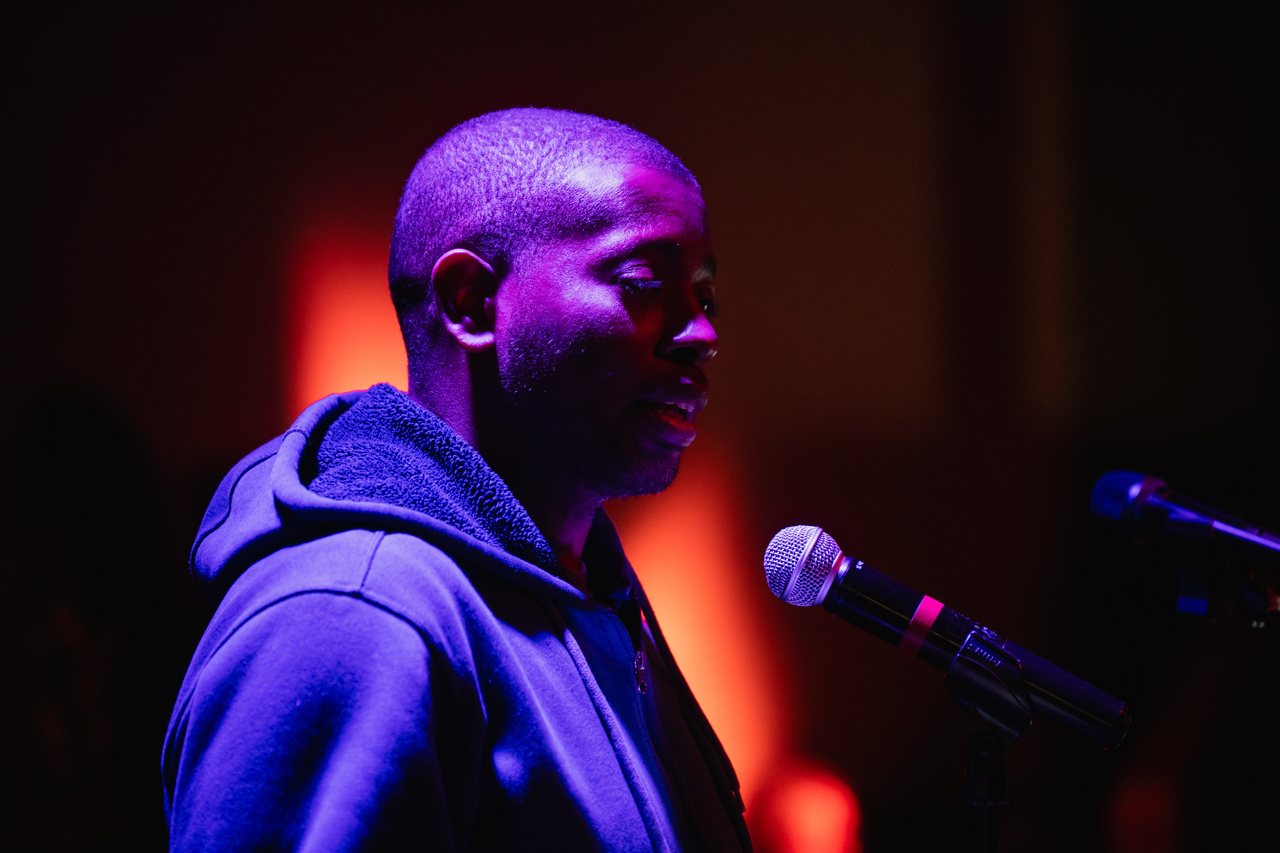
Marlo Browne is an award winning Barbadian poet, spoken word artist, hosted, film-maker and self-published author of 5 poetry books, currently residing in Langley City. He won two Gold Book Awards from Literary Titan in May and September 2025 for his fourth and fifth books respectively. Marlo is a very versatile poet and has been featured and performed at many events from galas to open mics at restaurants across BC. His first, second and 4th books, published in 2019, 2021 and 2023 respectively, all received 5 star reviews on Amazon. All of his books can be found on Amazon as well as several bookstores across BC including the Creative Bookworm in Langley, Wildfire Books in New Westminster, the UEL marketplace at the Loft on Granville Island and Windowseat Books on Nanaimo, just to name a few. His second and fourth books can also be found in Surrey Libraries. Marlo has also been featured twice for the ‘Authors Among Us’ program at the main branch of the Vancouver Public Library and now recently at the Guildford Branch for Surrey Libraries. He also did a reading at the Stathcona branch for the Vancouver Public Library. As a curator, Marlo was the curator for poets at the Vancouver Black Independent Film Festival as well as one of the curators for the inaugural Da Luv James Book Festival. Prior to that, he won the second iteration of the Da Luv Jones Poetry slam and is still the 2024 champion.
As a film-maker, Marlo’s first short film placed second in the short film category of the Langley City Film Festival.
As a host, he is one of the co-hosts of Wordsmith- a poetry event whose goal is not only put poetry at the forefront and to give more of a voice, but to create a space where BIPOC artists can perform more frequently. On top of that, he has collaborated with several non-profit organizations in order to bring awareness to these organizations. His recent collaborations include New Vision Music Society, the JrBAA, Hogan’s Alley, BC Community Alliance, Afiya Care Collective, Umoja Operations, Black Women Connect Vancouver, Raphael House, Foundry Langley and Tri-Cities, just to name a few.
He finished his fifth book in June and his second short film will be done at the end of September 2025. Recently, Marlo expanded his skill set by being an event organizer and coordinator. He was the event coordinator for the Harambeecouver Afro Folk Music Festival 2025 Prelude which occurred at the Shipyards in North Vancouver. He was also one of the organizers for the main 3 day Harambeecouver festival which occurred on August 8th-10th. Recently, Marlo and his friend Ivanna, through Wordsmith Poetry, are finalists in the Best New Business Category at the Black Excellence Awards. The premier of his second short film ‘Dear Single Mom’ happened recently at the Cultch with the Vancouver Black Independent Film Festival.
-
I am a migrant worker,
Meticulously muscling through
My menial job
While meandering through melancholy
At your mendacity,
I memorized moments,
That you made a mockery
Of the previous promises that you had made
To get us here,
Separated from our families
With the glimmer of hope that
We can have a better life,
Yet we have been victims of the three Rs:
Reused, recycled and returned
To our homelands with just the thought
Of remittances on our minds,
So we come,
Sometimes 6 or 8 months,
Year after year, with no way of
Becoming one of you:
A resident to a land where we built
Its economy,
Toiling in lands, side by side
To reap what you sowed
So that you could have a fine harvest,
I once heard a comedian make a joke
About picking cotton and
The room went silent as
All eyes turned to me,
Anticipating my response,
Yet they could not fathom a guess
As to what I'm thinking,
I..
Put up with deplorable conditions,
Picked fruits from large fields
In varying degrees of temperatures,
Putting them in baskets,
While you bask in your ignorance,
I went from having my own room,
To sharing a bunkhouse
With about 20 other guys in Ontario,
Yet you never wondered about my mental health,
Since I smile constantly,
Even though I am crying internally.
I am a migrant worker,
I am on a two year contract
In a province where I rarely see
Anyone who looks like me,
Not like me with regards to countenances,
But,
Like me, with regards to pigmentation,
Yet when I do, even though I do not know them
Personally,
I hail them,
Since we have to celebrate our existence,
We are tiny specks in a population
Of 5.4 million,
So I say hi to one of the 54000 black people
Since I know that
I work in a place where
Black history month is not celebrated,
Yet we only work 8 hours for Diwali,
I say hi,
Due to the fact that in order for
Our businesses to stand out,
We have to add the label 'black-owned',
I say hi
Due to the fact that even though
They consider us exotic,
Whenever I get on stage to perform,
The currency that they pay is attention
While the investment that they make is
One of emotion,
I say hi,
Simply because without the presence
Of migrant workers such as myself,
This country would not be as great as
You consider it to be,
So thank us as the risk of musculoskeletal disorders increases,
Make us feel welcome,
While we say
You are welcome.